How Much Do Cash Home Buyers Really Pay?

The short answer: most professional cash buyers pay between 60% and 80% of a home’s after-repair value, minus repair costs — with 70% as the industry baseline.
If you own a house that needs repairs, inherited a home through a trust or will, or need to sell on a tight timeline, you’ve likely asked yourself one big question: “how much do cash home buyers pay?”
It’s completely normal to feel cautious about off-market offers. Most homeowners worry they’ll get “lowballed” or scammed when dealing with cash home buyers.
Here’s the brutal truth: a cash offer will almost always be lower than the final retail price you see on Zillow. But there’s a catch: after agent commissions, repairs, and months of holding costs, the actual cash from a traditional sale is often far lower than the price on the listing.
Let’s peel back the curtain so you can see exactly how local cash home buyers calculate their offers, what a fair price looks like, and how to make the best decision for you and your family.
How Cash Home Buyers Calculate Their Offers
Reliable cash home buyers don’t make up offer numbers out of thin air. They rely on a simple real estate math formula based on your property’s future potential.
It all starts with a number called the After Repair Value (ARV). This is what your home would sell for on the open market if it were completely renovated and updated.
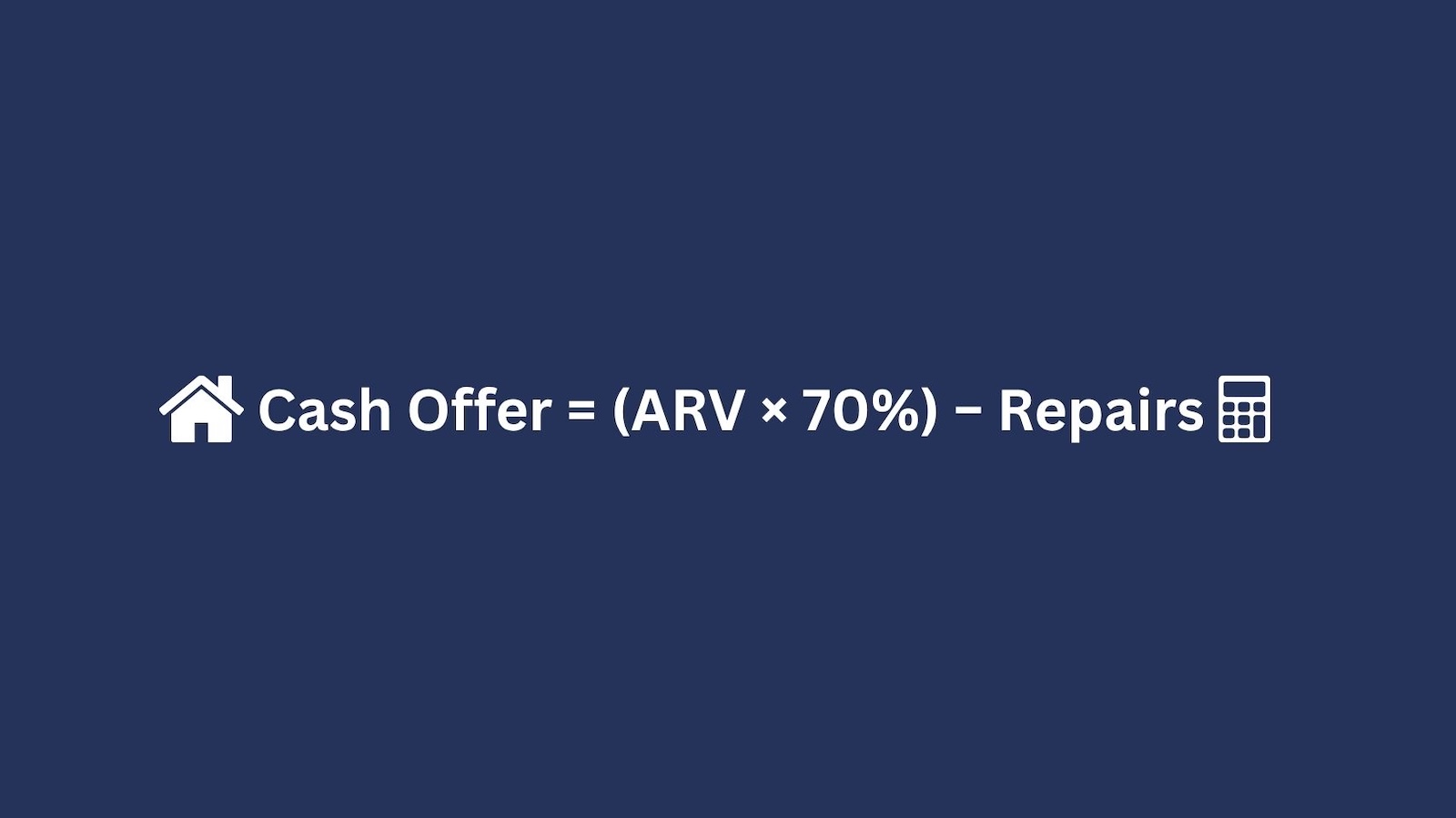
Many professional investors use a baseline standard known as the 70% rule. Here’s how that equation works in practice:
Cash Offer = (After Repair Value × 70%) − Estimated Repair Costs
So where does that other 30% go? It’s not pure profit for the investor.
That margin covers closing costs, escrow fees, carrying costs (like mortgage interest, property taxes, home insurance, and utilities during renovations), resale agent commissions, and a safety cushion for unexpected repair delays.
The Net Proceeds Trap: Gross Price vs. Actual Cash in Your Pocket
When you list a home on the open market with a real estate agent, it’s easy to focus on the headline sales price or what your neighbor’s house sold for on Realtor.com or Zillow. But that gross number is rarely what you take home.
Selling with a real estate agent comes with a long list of out-of-pocket expenses that slowly eat away at your home equity.
As of Summer 2026, this is what typical sellers pay during a traditional market sale:
- Realtor Commissions: Typically, 5% to 6% of the total sale price.
- Closing & Title Fees: Usually 1% to 2% paid out by the seller.
- Pre-Listing Repairs & Staging: Spending thousands on paint, flooring, roof fixes, or landscaping just to attract buyers, which is around 10% to 15% of ARV for a home with typical deferred maintenance.
- Seller Concessions: Price cuts or repair credits requested by buyers after home inspections: 1% to 3% of the purchase price due to rising mortgage rates.
- Monthly Carrying Costs: Paying your mortgage, property taxes, insurance, and utilities every month the home sits on the market which costs (around ~$3,800 for a $500k home).
A Real-World Example: Traditional Sale vs. Direct Cash Sale
|
Expense Item |
Traditional MLS Listing |
Fast Sale to Cash Home Buyer |
|
Gross Purchase Price |
$500,000 |
~$306,250 |
|
Agent Commissions (5.5%) |
$27,500 |
$0 |
|
Seller Closing Costs (1.5%) |
$7,500 |
$0 (Covered by Buyer) |
|
Out-of-Pocket Repairs (12.5%) |
$62,500 |
$0 |
|
Seller Repair Credits / Concessions (2%) |
$10,000 |
$0 (Closes in days) |
|
3 Months Carrying Costs (Taxes, Mortgage, Utilities) |
~$11,400 |
$0 |
|
ESTIMATED NET TO SELLER |
~$381,100 |
~$306,250 |
The ~$306,250 figure is estimated from the 70% rule: ($500,000 x 0.7) − $43,750. The $43,750 repair estimate is the $62,500 retail repair bill minus a 30% discount, because experienced investors complete renovations for 20% to 40% less than a retail homeowner pays for the same work. This is due to the cash buyer’s steady workstream to subcontractors that charge less in exchange for more job stability or the cash buyers’ connections with wholesalers for housing materials.
When you compare the actual take-home proceeds of a traditional listing versus a direct cash sale on a home with deferred maintenance, the difference in pocketed cash is often much smaller than you’d expect. For homes needing extensive repairs, that gap closes even further — and in some cases, a cash buyer can net you more. Plus, you completely skip months of open houses, costly renovations, and the stress of deals falling apart.
What Factors Drive Cash Offers Up or Down?
Not every house receives the exact same cash offer. Several factors determine how flexible cash home buyers can be with their pricing.
1. The Scope of Needed Repairs
A house that only needs cosmetic updates like fresh paint and carpet will receive a higher offer. Homes requiring major structural fixes, roof replacements, or mold removal will lower your offer, because cash buyers have to factor in the full repair and renovation costs.
2. Property History and Legal Complexity
Properties involving probate, non-paying tenants, or property liens require additional legal work. This added complexity increases the risk the buyer takes on. The less complex, the higher your cash offer typically is.
3. Micro-Market Demand
In high-demand areas across Riverside County and the Inland Empire, local cash home buyers can often pay closer to 75% to 80% of ARV. Shorter holding times mean lower risk for the buyer.
iBuyers vs. Wholesalers vs. Local Cash Home Buyers
Who you ask for an offer plays a massive role in how much cash home buyers pay.
iBuyers (Tech Corporations)
Large corporate iBuyers use automated algorithms to make offers. They pay closer to market value, but they only buy turnkey homes in great condition and charge 5% to 7% service fees.
Turnkey home: a move-in-ready home that requires no repairs, cleaning, or renovations before you can live in it.
Wholesalers (Middlemen)
Wholesalers don’t actually buy your house with their own funds. Instead, they put your home under contract and try to sell that contract to an end investor for a fee. They often offer lower prices and carry a risk of canceling if they cannot find a buyer.
Local Cash Buyers
Local, direct cash buyers use private capital, understand market trends in your area, and are willing to meet with you in person. Because they have much lower overhead than corporations do, nearby cash home buyers can offer competitive prices and close through licensed local title companies.
Red Flags: How to Avoid Lowball Scams
While most cash buyers run legitimate businesses, you should protect yourself from common red flags.
- The “Highball” Bait-and-Switch: Beware of buyers who give a high offer verbally to lock you into a contract, only to demand a massive price drop later.
- No Proof of Funds: Always ask for a bank statement or official letter showing the buyer actually has the funds to close.
- Upfront Fees: You should never pay application or processing fees to get an offer. Legitimate cash buyers will assess your home’s value and give you an offer for free. And they’ll never ask you to pay for closing costs.
FAQs
See What a Real Cash Offer Looks Like for Your Home
Understanding how much cash home buyers pay comes down to looking at your net walk-away cash. While a cash offer includes an “as-is” discount, it delivers speed, certainty, and zero out-of-pocket costs — peace of mind is also an asset!
At Exclusive SoCal Home Buyers, we believe in total transparency with our cash offers. We’re a local, family-operated team of three brothers serving Southern California homeowners. We show you all the math behind our numbers, so you can choose the path that best fits your needs.
Want to see what a competitive cash offer looks like for your home? Contact us today for a free, zero-obligation cash offer with a clear breakdown of our numbers!